
How Time Tracking Data Transforms Multi-Year Financial Models: Strategic Financial Forecasting Series Part 1

Time tracking data represents a strategic asset for financial forecasting. We’re excited to bring you this series of guest posts from fractional CFO and forecasting expert Salvatore Tirabassi, where he’ll explore how time data fuels accurate financial forecasts. Whether you’re a seasoned CFO or building out your first forecasts, this series offers practical insights into how time tracking can power better financial decisions.
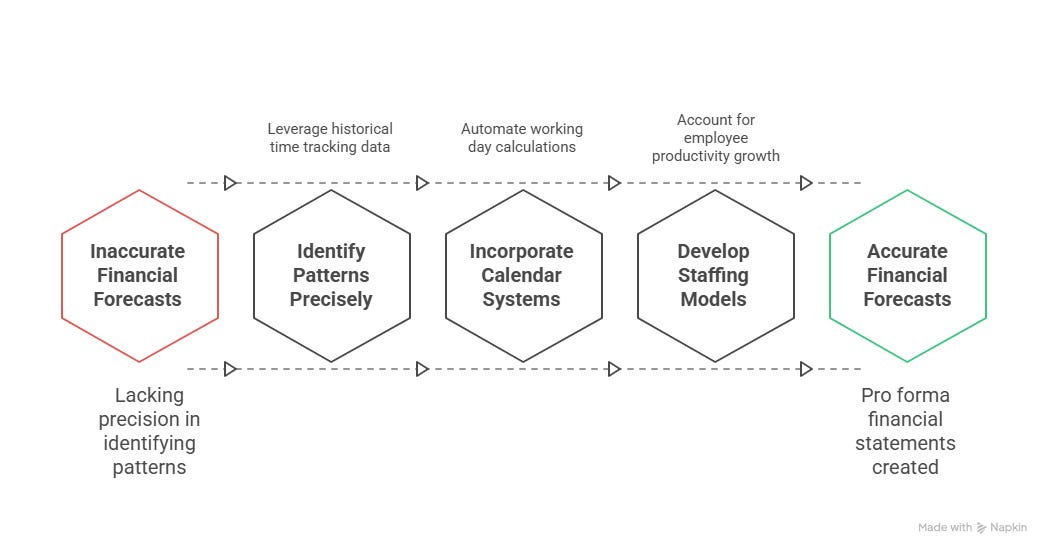
Historical time tracking data allows you to identify patterns with precision, and I’d like to introduce some ideas on how to utilize time tracking data effectively in a repeatable forecast. Financial forecasting tools, including advanced software, can leverage this data to create pro forma financial statements for more accurate projections. A sophisticated view of time tracking takes into account important but challenging drivers like seasonality, working days, overtime propensity, and other factors that could improve the accuracy of your forecast dramatically.
As a fractional CFO, I see many businesses that require time tracking. Utilizing a great time-tracking platform provides excellent data for future forecasting. CFO Pro+Analytics builds 3-statement financial forecasts with financial forecasting reported monthly (and weekly for cash forecasts). These forecasts are built through structured financial forecasting processes and rely on accurate financial statements and inputs from other systems. The 3-statement financial forecast is “one model to rule everything.” It is designed for use in monthly budgeting, scenario planning, investor relations, and other purposes. We like this methodology because keeping more than one forecast in sync is very challenging, and it results in more questions about why things differ between two forecasts.
In this series of articles, I’ll cover three critical areas where time tracking data elevates your financial modeling: labor forecasting in multi-year models, incorporating automated calendar systems for working day calculations, and developing staffing models that account for employee productivity growth over time.
Why Accurate Financial Forecasting Drives Strategic Success
Financial forecasting extends beyond number crunching. By providing a clear view of future financial performance, it enables businesses to predict future outcomes, identify potential risks, and make strategic decisions about investments and resource allocation. And let’s face it—reporting actuals that are within a percentage point or two of your forecasted estimates builds confidence in your decisions, and it feels good. A proactive approach enables organizations to maintain stability and pursue their financial objectives with confidence.
This type of accuracy does have real payoffs. One of my manufacturing clients hit $2.47 million in Q3 revenue against the $2.52 million forecast—within 2%. The board approved the $800,000 equipment purchase that the CEO wanted without the usual back-and-forth, simply because they trusted the numbers were solid. That equipment let them take on a contract six months later that their competitors couldn’t handle due to capacity constraints. Had the variances been larger, there would have been a mood shift in the wrong direction and would have pushed out the decision-making.
Challenges of Financial Forecasting
One of the primary difficulties of financial forecasting lies in the inherent uncertainty of future events—it can be challenging to predict future financial performance with complete accuracy. Reliable financial forecasts rely on access to accurate and comprehensive data; however, gathering and maintaining such data can be a significant hurdle for many organizations.
Consider the kind of scrambling businesses have had to do with the 2025 tariff uncertainty. Each week brings a new set of challenges with each news cycle. If your financial data is not well organized, analyzing and planning for these frequent and extreme pivots could turn an immediate decision into something that takes weeks.
How to Build Seasonal Labor Models from Time Tracking Data
One of the most overlooked aspects of financial forecasting is fluctuating demand for labor, and this is where historical data from time tracking platforms becomes invaluable. Many businesses experience dramatic fluctuations throughout the year that directly impact budget allocation and cash flow planning.
Consider a client-facing department whose onboarding demands skyrocket in Q1 as clients prepare for the year ahead. Without proper labor demand forecasting, you’ll be unprepared to accommodate the extra internal costs associated with this period.
Historical data from robust time tracking systems allows you to identify these patterns with precision. When I build multi-year financial models for clients, I extract 24-36 months of time tracking data to establish clear baselines. In addition to time tracking, analyzing labor costs is critical for projecting necessary budget allocations and anticipating cash flow in a given period. Here’s how to approach this:
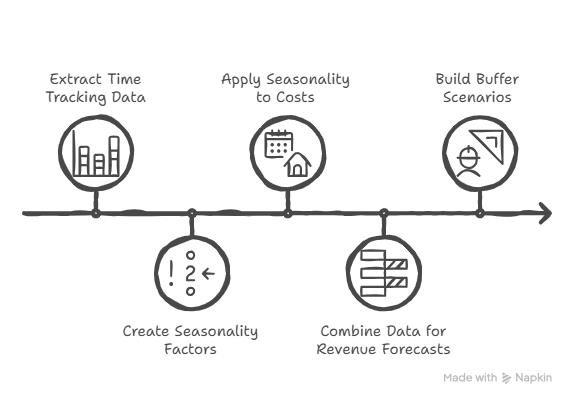
Here’s the Step-by-Step Process:
1. Create seasonality factors by month for each department or service line:
For example, if January typically shows 65% of average monthly hours for customer service, but June shows 140%, these become your seasonal multipliers. Detailed project and task tracking from sophisticated time tracking solutions provides the granular data needed to build these factors accurately. Use this data to create confirmed assumptions that will be used in your seasonality curve.
2. Apply seasonality to direct costs:
Your seasonality curves can now be applied to provide a more accurate picture of direct costs throughout the year. Suppose your customer service hours drop 35% in January. In that case, your support costs should reflect this.
3. Combine time tracking and sales data to apply seasonality to revenue forecasts:
The seasonality curves you’ve built might be useful in other parts of your model beyond
4. Build buffer scenarios around your seasonal model:
Time tracking data helps you understand not just average seasonality, but the range of variability. If customer service hours in December historically range from 110% to 160% of baseline, you need scenario planning that accounts for this variance in your cash flow forecasts. Market fluctuations can further impact both revenue and cost projections, so it’s important to factor in economic variability and potential risks when planning. Here’s an example: if your business is interest-rate sensitive or exposed to macroeconomic swings, allocations and time-off tracking can help simulate how changes in headcount or working hours could impact
Conclusion
Time tracking data represents one of the most underutilized assets in financial planning. By building seasonal models from historical time data, you transform forecasting from reactive reporting to proactive strategic planning. Analyzing past performance helps set realistic expectations for future outcomes and ensures your financial plans are grounded in real historical trends.
Frequently Asked Questions (FAQs)
1. How can time tracking data improve financial forecasting accuracy?
Time tracking data provides detailed insights into how employees spend their time across projects and tasks. By analyzing historical time data, businesses can identify seasonal patterns, allocate resources more effectively, and forecast labor costs with greater precision. This leads to more reliable financial models and better-informed strategic decisions.
2. What role does seasonality play in labor forecasting?
Seasonality reflects fluctuations in labor demand throughout the year, such as increased customer service hours during peak months. Incorporating seasonality factors from time tracking data allows businesses to adjust their labor budgets and cash flow plans accordingly, avoiding under- or over-staffing and optimizing operational efficiency.
3. Can small businesses benefit from using time tracking data in their financial models?
Absolutely. While large organizations often have sophisticated systems, small businesses can also leverage time tracking data to gain insights into employee productivity, project costs, and resource utilization. This information supports smarter growth decisions and helps improve profitability even with limited resources.

At CFO Pro+Analytics, we partner with founders and owners to deliver clarity, confidence, and control. Together, we can design a roadmap that connects your ambition with a sound financial strategy.
CLICK HERE to schedule a free 20-minute consultation call
Practical methodology - especially layering seasonality factors from time data into labor and cash flow forecasts. That granular approach to operational cash cycles mirrors what’s needed in trade credit and working capital planning, where payment terms, DSO, and supplier timing often have their own seasonal patterns. TCLM often explores that financial operations layer, connecting such operational rhythms to liquidity and credit decisions. A valuable read for finance teams building more responsive models.
(It’s free)- https://tradecredit.substack.com/